
Scale the Highest Climbable Peak in the Indian Himalayas — Zanskar Range, Ladakh
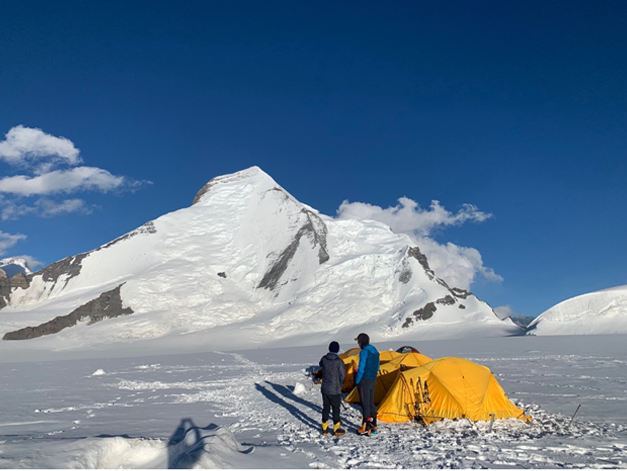
Mount Nun (7,135m) is the highest peak in the legendary Nun-Kun massif and India's highest climbable mountain, rising majestically from the remote Suru Valley in Ladakh's Zanskar Range. Its twin summit, Mount Kun (7,077m), completes one of the most iconic high-altitude challenges in the Indian Himalayas.
Summiting Mt. Nun is far more than a personal milestone — it is a gateway to the world's elite mountaineering circuit. The expedition provides priceless high-altitude experience that prepares climbers for ascents above 7,500m and select less-technical 8,000-metre peaks.
Zanskar Kanishka Expeditions, a J&K Tourism-registered operator and member of ALTOA (All Ladakh Tour Operators Association), has been guiding climbers safely through the Himalayas for years. Our locally rooted team combines IFMGA-certified leadership with deep knowledge of the Zanskar terrain, ensuring every expedition is not just thrilling — but safe.
To ensure the welfare of every team member, we require all applicants to have previously summited at least four 6,000m peaks — such as Lobuche East, Island Peak, Chulu West, or Kang Yatse I — or equivalent (Kilimanjaro, Elbrus, Aconcagua, or Mont Blanc). Your alpine history is thoroughly verified before a place is confirmed.
India's highest climbable summit — the crown of the Nun-Kun massif in the Zanskar Range.
Graded AD/4, combining glacier travel, mixed terrain, and fixed-line technical sections.
The dry summer window offers optimal snow stability and the clearest summit days.
All lead guides carry IFMGA certification with 6,000m–8,000m expedition experience.
Only 1 day of trekking to reach Base Camp at 4,500m from the roadhead at Tangol village.
Extend your expedition to include a summit bid on Mt. Kun (7,077m) — inquire for details.
Every detail of the Nun Kun Trekking Expedition is designed to maximize your summit chances while keeping safety non-negotiable.
Three progressive high camps (C1, C2, C3) with structured rotation days to optimize acclimatization.
A full 12-day climbing period includes rotation days, mandatory rest, and weather contingency buffer.
Four lead guides + four assistant guides for a group of four clients — unmatched personal safety coverage.
One supplemental oxygen cylinder kept at Base Camp for emergency use throughout the expedition.
Acclimatization days include guided visits to Leh's ancient monasteries, palaces, and Pangong Lake.
Expedition tents, sleeping tents, mess tent, dining tent, toilet tent, gas, burners — all provided.
A meticulously phased acclimatization program starting from Leh (3,524m), progressing through Kargil, Tangol, and into the Nun Base Camp. Days 9–21 constitute the core climbing period.
| Day | Activity & Highlights | Altitude | Accommodation / Meals |
|---|---|---|---|
| Day 1 | Arrival in Leh — Airport transfer, check-in & welcome briefing | 3,524m | Hotel · B&B |
| Day 2 | Acclimatization in Leh — Leh Palace, Shanti Stupa, local market exploration | 3,524m | Hotel · B&B |
| Day 3 | Drive Leh → Pangong Lake via Chang La Pass (5,360m) | 4,350m | Guesthouse · AP |
| Day 4 | Acclimatization at Pangong — sunrise walks & high-altitude adaptation | 4,350m | Guesthouse · AP |
| Day 5 | Drive Pangong → Leh — equipment check & team gear fitting | 3,524m | Hotel · B&B |
| Day 6 | Drive Leh → Kargil via Fotu La & Namika La passes | 2,676m | Guesthouse · AP |
| Day 7 | Drive Kargil → Tangol (roadhead village) — expedition briefing | ~3,300m | Camp · All Meals |
| Day 8 | Trek Tangol → Nun Base Camp through Suru Valley glacial terrain | 4,500m | BC Camp · All Meals |
| Days 9–21 | Climbing Period — Camp rotations to C1 (5,500m), C2 (6,100m), C3 (6,400m); summit bid to Nun Peak (7,135m); rest & contingency days included | 4,500m–7,135m | High Camp · All Meals |
| Day 22 | Trek Base Camp → Tangol & drive to Kargil — expedition close | 2,676m | Hotel · AP |
| Day 23 | Drive Kargil → Leh — farewell dinner in Leh | 3,524m | Hotel · B&B |
| Day 24 | Departure from Leh Airport — expedition memories last a lifetime | 3,524m | Hotel · B&B |
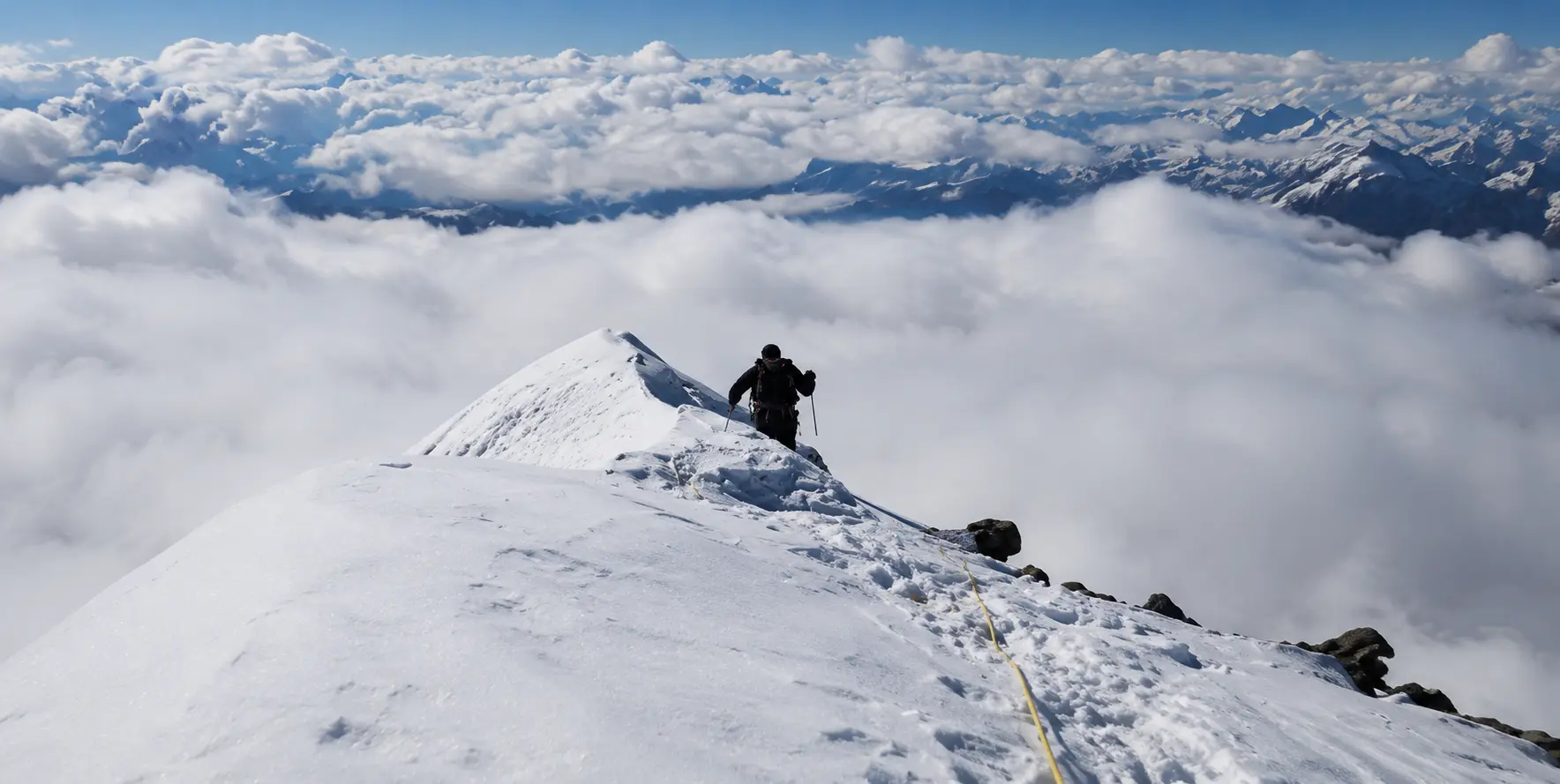
The expedition ascends via the Western Ridge, widely recognized as the safest and most accessible line on the mountain. Fixed ropes are pre-installed on all technical sections.
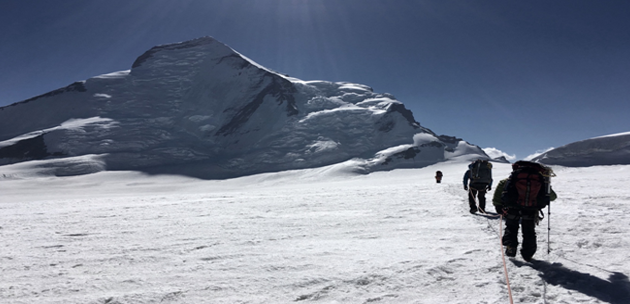
Depart Base Camp across steep scree slopes and rocky moraine before reaching the glacier tongue. Fixed lines guide the team safely through crevassed sections, opening onto the spacious snow plateau where Camp 1 is established.
A demanding mixed-terrain leg traversing snow, ice, and rocky bands. Fixed ropes are employed throughout this ascent, leading to Camp 2 perched on a narrow but sheltered crevassed col — a critical altitude milestone for your acclimatization.
Roped teams navigate complex crevasses before ascending exposed ice slopes that lead to the intimate plateau of Camp 3. This high camp serves as the final rest point before summit day.
An alpine start in pre-dawn darkness. The summit slope presents steep snow and ice with challenging rock sections beneath the final snowfield. Fixed lines are installed throughout. Upon reaching the summit, the descent begins to Camp 3, completing the full descent to Nun Base Camp the following morning.
High-altitude mountaineering carries inherent risks. Our protocols — honed over years of Himalayan expeditions — ensure every decision on the mountain prioritizes life over the summit.
Snowstorms, high winds, or rapid temperature drops can significantly elevate risk. When forecasts deteriorate, we turn back — no summit is worth a life.
Any team member showing serious symptoms of AMS, HAPE, or HACE will be immediately evacuated to lower altitude. Our guides are trained in high-altitude medical first response.
Unstable snowpack, rapid temperature changes, or shifting terrain trigger mandatory route assessment. Alternate lines or descent may be called at any time.
Pre-set turnaround times at each camp and summit stage are enforced without exception to avoid dangerous descents after dark or in worsening conditions.
Supply shortages, communication failures, or equipment breakdown will trigger an orderly and controlled descent. 12-day climbing windows include contingency buffer days.
All participants must carry comprehensive travel insurance covering high-altitude rescue and helicopter evacuation above 7,000m. Proof must be provided before departure.
Slots for the 2026 Nun Kun Trekking Expedition are strictly limited to maintain our 1:1 guide ratio. Reach out today to check availability and begin your application.
WhatsApp Us Now Email Your QueryOur guests' words are the most honest reflection of the experiences we craft in the wild heart of Ladakh.